(Week 6) Knocks Me Off My Feet

Knocks Me Off My Feet

This week’s track is off one of my favourite albums of all time: ‘Songs in the Key of Life’ by Stevie Wonder. I first heard it while at university and it didn’t leave my Minidisc (showing my age) player for about 6 months. An interesting fact about this tune is that all the instruments were played by Stevie himself! That’s right, as well as being an incredible singer, songwriter, arranger and pianist he was also a great drummer and great (synth) bassist.

There’s a real James Jamerson influence in this one. Have a look at the final section in Db, those lines could have been played by Jamerson himself. It’s clear that all those years playing with him really rubbed off. Pay attention to the note lengths in this tune; almost the whole line is staccato. Also make sure to nail the hammer ons to really get the vibe. Enjoy the Db section! I’m sorry for the double flats, they’re enharmonically correct though.

I recorded this on my Fender 50s Precision Bass with Ernie Ball Slinky Flatwounds. The tone was at about 20%. I used my Diamond BCP-1 compressor with a hint of compression and a touch of EQ boost. I then went into my new Tech21 VT DI pedal, added a little bit of mids and went for a general SVT tone. I added some compression in Logic using the Vintage FET setting and a slight EQ bump at around 1khz.

Thanks for reading. If you like the song, make your own video and tag me on social media, @jproudbass on twitter and instagram.

Till next week.


(Week 5) Holy Wars…The Punishment Due

Holy Wars…The Punishment Due

It’s nice to change things up. I don’t do a lot of plectrum playing and I never get to play metal so this is a real challenge/treat. Taken from THE BEST thrash metal album of the 90s, this is a 6 min epic with plenty of downpicking and palm muting, bassists can do that, right?

For a lot of the song the bass follows the guitar part which means fast picking and lots of hammer ons/pull offs. Take your time with this one, start slow, make sure you’re playing it right and work up to the original tempo (around 162bpm). What really helped me was playing along with the isolated drum track on youtube. Hearing the drums clearly makes it much easier to lock in with your right hand. It took me a few days of practise to get this one down, and I still make 3 mistakes in the video!

Pay attention to where I’m downpicking in the video, it’ll help with getting the feel. Most rock/metal bass playing requires focused aggression (playing wise). Playing hard enough that the tone and feel is right but also nailing the rhythmical elements. There’s an isolated drums and bass version of this on youtube. I recommend searching it out for a clinic in thrash metal bass and drums. Rock solid.

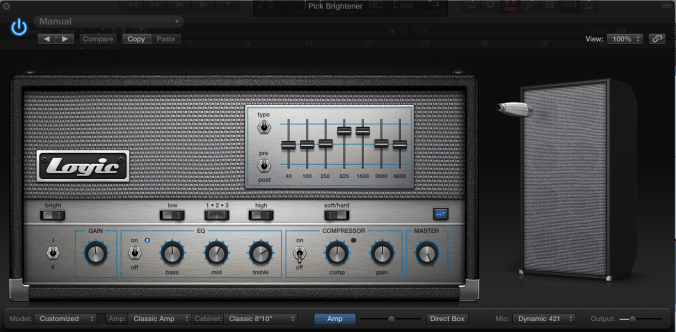
This was recorded on my custom built 5 String with Aguilar DCB pickups and an Aguilar OBP-3 preamp. I used a fairly thin plectrum. I had the neck pickup on full and a tiny bit of bridge pickup to add a bit of top end. I boosted the mids fully with the push/pull pot pulled up. I went straight into logic and used the SVT simulated amp with these settings:

screen-shot-2017-02-01-at-18-11-34


Full poweramp gain and some added high mids and treble to bring out the plectrum sound. I then added some fairly heavy compression (vintage FET mode) and blended in a little of the Double Dragon overdrive. I added a noise gate as there was a slight hiss from the overdrive/gain stages.

Thanks for reading. If you like the song, make your own video and tag me on social media, @jproudbass on twitter and instagram.

Till next week.

Click here to download PDF transcription


(Week 4) Baby Be Mine

Baby Be Mine

Sometimes it’s good to learn lines that were played on instruments other than bass. For jazzers it’s often sax or piano solos, anything that takes you out of your standard hand positions and note choices. In the pop world, it’s great to learn basslines that were written and played by keyboard bassists. It can be a rewarding challenge trying to follow the articulation and general groove.

This weeks bassline was played by Greg Phillinganes on what sounds like a moog synthesiser. It’s best played on 5 string but I’ll include an octave up transcription for anyone that wants to play it on 4 string or with an octave pedal.

Once again it will benefit you to really pay attention to the articulations if you want to nail this groove. Watch out for the staccato notes and hammer on/pull offs/slides. They really help with getting the vibe. If you listen properly you’ll hear Greg playing around with the feel. Sometimes ahead of the beat, sometimes behind. I’ll leave you to figure out where they are! It can be a fun challenge to try to slap this whole bass line. The choruses sound particularly good slapped.

This was recorded on my custom built 5 String with Aguilar DCB pickups and an Aguilar OBP-3 preamp. I soloed the bridge pickup, boosted the bass slightly and boosted the mids a lot. I ran it through my  Markbass Compressore with a quick attack and release and the threshold set to where most notes were compressed. I then went into a Diamond BCP-1 compressor with a slight boost on the 900hz side a smidge of compression. In Logic I added some vibrato and chorus to get a more synthy vibe.

(In order to be in tune with the recorded version of this song you’ll need to set your tuner to 446hz)

Thanks for reading. If you like the song, make your own video and tag me on social media, @jproudbass on twitter and instagram.

Till next week.

Click here to download PDF transcription

Click here to download PDF transcription (octave up)

 (Week 3) I’m Gonna Tear Your Playhouse Down Transcription/Video

I’m Gonna Tear Your Playhouse Down

Frets? Where we’re going, we don’t need, frets. Back to the 80s that is, for this classic Pino Palladino line from Paul Young’s cover of “I’m Gonna Tear Your Playhouse Down”. Grab your fretless and your Boss OC2 and join me. Mullet optional.

In this tune, Pino uses his fretless and octave pedal to great effect. It’s a masterclass in use of space and counter melodies on the bass. See if you can spot the Jaco influence.

The key to getting this one to groove is to pay attention to note lengths. Give those crotchets their full value, cutting them off just before the snare. Also watch out for the staccato notes in the choruses; they’re super important for nailing the feel. Those squiggles above some of the notes are vibrato symbols. This is achieved by rocking your fretting finger side to side or sliding very slightly backward and forwards. On a fretless the note should “sing”.

Now, the arpeggios at the end. These may require a little practise. For the theory buffs among us the first arpeggio is a up a Gmin11 chord and then down the third then root. The next is a straight Cmin7. The following one is essentially a Gmin11 played in fourths. The flourish towards the end is down a blues scale from b5 to b7 in 2 groups of 5 and a group of 6 that ends on the 5th. An incredible lick to stick into a mainstream pop song! The whole song might take some getting together but it’s definitely worth putting the work in.

Gear wise on this one I’m using my home constructed fretless bass with Seymour Duncan Steve Bailey pickups and Thomastik-Infeld flatwounds. Neck pickup off, Bridge and tone at 100%. I’m using a Markbass Compressore with a pretty quick attack and the threshold set so about 90% of the notes played are compressed. Ratio is set at 12 o’clock. Next is a Diamond BCP-1 with the compression off and a good EQ boost with the toggle set to 900hz mode. That’s going into a Boss OC2 with octave 1 off, octave 2 at around 90% and the dry all the way up. I added a little reverb with a Moore Shimverb that I picked up the other day.

I’m running that into Logic and using the SVT simulation with the golden fingers preset and then some light compression with a low threshold to tie it all together. Enough processing for you?! 80s tastic.

Thanks for reading. If you like the song, make your own video and tag me on social media, @jproudbass on twitter and instagram.

Click here to download PDF transcription


(Week 2) Ziggy Stardust Transcription/Video


Ziggy Stardust

A slight change of pace for this week’s installment. After the fingerstyle funk of “In The Stone”  I thought I’d give you some plectrum/pick style rock with David Bowie’s “Ziggy Stardust”.

This bass line makes great use of chromatic approach notes and alternates between following the vocal and “filling in the gaps”. It’s too easy to rush the more rhythmical elements of this one so try to sit back and listen to the drums. Also watch the tempo shifts between sections! Gotta love that early 70s rock ‘n’ roll sensibility, just let the song flow man.

I recorded this using a Dunlop Delrin 500 2mm plectrum on my Fender 50s Precision bass (strung with EB Slinky Flatwounds) going into a Diamond BCP-1 with a little compression and EQ boost in 900hz mode. Then into my EHX Bass Soul Food to add some tasty drive. In Logic I added some compression using the vintage opto setting.

Thanks for reading. If you like the song, make your own video and tag me on social media, @jproudbass on twitter and instagram.

Till next week.


Click here to download PDF transcription


(Week 1) In The Stone Transcription/Video

In The Stone

I’ve decided to set myself the challenge of doing a transcription/video every week for the whole of 2017. I missed the first week due to work commitments so there’ll be 2 this week and another 50 over the rest of the year! Gulp!

I’ll be aiming to release each video on the Monday of each week so feel free to learn each song with me and expand your musical vocabulary. Any suggestions for tunes will be helpful. As groove based as possible though I’m open to some more of the heavier stuff as long as the bass is reasonably audible!

This week’s first tune and the first of the year is ‘In the Stone’ by Earth, Wind & Fire. I was always aware of EWF but properly got into them while driving back from gigs late at night and needing some upbeat music to keep me going. I was amazed by the ambitious arrangements and chord sequences, the rock solid drum grooves, and the sublime pocket playing of Mr Verdine White. This tune always stuck out to me due to it’s brilliant game show style intro and the easy sounding but difficult to nail bass grooves.

Most of the bass line can be played on the first 5-6 frets apart from the odd flourish at frets 7-9. It’s played in a very precise manner with lots of staccato notes which is reflected in the transcription. The key to getting this song to groove is relaxing, try not to rush all the semiquaver pushes and feel the spaces. Watch the video and study the score. Count if you need to but the aim is to feel the rests rather than count them! Get practising those semiquavers.

Best of luck with this one, I hope you enjoy playing it as much as I did.

This was recorded on my custom built 5 String with Aguilar DCB pickups and an Aguilar OBP-3 preamp. The front pickup was rolled off by about 60-70%, I boosted the bass slightly and boosted the mids with the push-pull pot in the up position. I ran it through my Diamond BCP-1 compressor with a slight boost on the 900hz side into Logic where I boosted the EQ by 2.5db at around 1khz with a Q of .30. I then added some light compression.

Thanks for reading. If you like the song, make your own video and tag me on social media, @jproudbass on twitter and instagram.

Till next week.

Click here to download PDF transcription

L.O.V.E. Transcription/Video

L.O.V.E.

This song first came to my attention in the advert for Chanel’s Coco Mademoiselle perfume starring Keira Knightley. That probing melodic bass part made my ears prick up and I had to know who played it. A bit of internet research later and I found it was none other than one of my favourite players of all time, Mr Raphael Saadiq (who also produced the album the track is from).

The song moves through 3 keys (G Ab and A) so i hope you’ve been keeping up with your reading! It’s got a swung 16th/Semiquaver feel and Raphael plays it with his characteristic laid back intensity, “always keep the bass moving”.

Not much more to say on this one, I’m mostly playing standard major scale shapes (2nd finger on root) or box shapes based around the root or fifth of the chord. Everyone I’ve seen plays it differently so have fun figuring out the best way for you, or watch the video and use my fingerings 🙂

This was recorded on my 50s reissue Fender Precision bass strung with Ernie Ball Slinky Flatwounds with a ’62 reissue pickup and a foam mute under the strings at the bridge. I recorded direct into my mbox2 into Logic and added a little compression and an eq bump at 200hz  and 1340hz.

Click here to download PDF transcription


Girlfriend Transcription/Video

Girlfriend

This is one of Michael Jackson’s lesser hits from the ‘Off The Wall’ album. It was originally written by Paul McCartney for Michael but ended up being recorded by Wings instead. When Quincy Jones was approached to record it for Michael he had no idea it was originally written for him.

It features a great and well developed bass line by the late Louis Johnson. The line is mostly based on pentatonic and and box shape patterns but it’s the rhythmic aspect and development that makes this one interesting.

It’s in the key of E major and mainly stays within key excluding the D9 chord in bars 19, 33, and 61.

For the line in bar 2, 10 etc I play use a standard pentatonic shape starting on the open E string then slide from the F# (D string 4th fret) onto the G# ending in 4th position)

The penatonic riff in bar 4 is repeated at the end of verse phrases throughout. I would grab the high G#  on the G string (1st Fret) and then play this in 2nd position (first finger on the second fret).

Almost everything else in the song in based around the box shape or basic octaves. Take your time and make sure you have the semi-quaver rhythms nailed and try not to rush.

This was recorded on my 50s reissue Fender Precision bass with ’62 reissue pickups. I recorded direct into my mbox2 into logic and added a little compression and an eq bump at 200hz.

Click here to download PDF transcription


Trippin’ Transcription/Video

Trippin’

I’ve been a huge fan of Raphael Saadiq’s playing since I heard this Lucy Pearl track around 2006/7. It’s the bass line that just keeps going! I’ve always fancied learning it properly so thought I’d do a transcription/video while I was doing it.

First up, 4 string players, tune your E string down to D. 5 stringers, you’re all good to go. The whole song is based around a 2 octave D minor pentatonic bass lick. Start in 5th position, assuming you’re using the 1,2,4 fingering method, with your 4th finger on the D on the 7th fret of the G string. If you play both the Ab and G with your 4th finger you end up in 3rd position. Shift to 2nd postion to get the F and E on the lowest (D) string. 5 String players, you’re working with a basic minor pentatonic shape rooted on the D (3rd fret) of your B string.

While the bassline itself isn’t technically difficult, copping Raphael’s feel can be a challenge. He’s playing around with the time, sometimes ahead of the beat and sometimes right behind. Listen to the phrasing in the first bar of the lick, the 2nd semiquaver is ahead of the beat then the whole thing settles to slightly behind in the second bar. The whole thing’s played fairly staccato which requires good right hand muting and relaxed but precise plucking. Try some foam under your bridge to dampen the strings slightly. The general vibe is chilled out intensity. Keep those semiquavers consistent but behind the beat! I still have some work to do to really nail the groove on this one. Keep practising.

This was recorded on my 2000 American Std Jazz Bass into a sansamp BDDI (with plenty of drive) into Logic Pro X via my mbox 2. I added a little compression and bumped the EQ at around 200hz and 2khz.

I hope you enjoy playing through this tune.

Click here to download PDF transcription


You’re My Best Friend Transcription/Video

You’re My Best Friend

I recently bought Queen’s Greatest Hits 1+2 on CD for the car. The first thing that struck me was John Deacon’s inventive and lyrical bass lines. So much so that I decided to learn a few of them. Queen bass transcriptions are few and far between online and are usually pretty inaccurate so I decided to do my own. This is note for note as played on the record (including John’s cheeky overdub at bar 78).

The bass part is triplet heavy, so much so that it could be written in 12/8. However I feel the general groove is more a 4/4 with a little swing. A noteworthy feature of this line is that it doesn’t require the use of the E string, at all! John was of the few players that could play right up the neck and still have a full round bottom end. It’s worth listening carefully to the drums in this tune as a lot of the bass fills are locked right in with drums. The song’s in C so all that Cmajor pentatonic practise will pay off. Also, have fun reading the ledger lines in the chorus!

I recorded this on my Epiphone Jack Casady signature bass (with the pickup set to 250hz) straight into Logic Pro X via my Mbox 2 (No DI). I added a little compression and a EQ boost around 150hz and 1khz.

Click here to download PDF transcription